
Long before the scientific method divided the natural world into the animal, mineral and vegetable kingdoms, human beings were born with the intuitions and necessary skills to stay tightly interconnected with planetary systems, in order to survive.
Late winter harvest produced less food than late summer so they knew where to be unless the gazelles were migrating. If gazelles changed their migration pattern, humans had to decide between developing a new dinner menu or finding a new route. Either choice would have been made reluctantly. People, generally, resist giving up familiar routines unless forced by rivals or ruined by climate.
Climate change may have motivated human progenitors, including H. Erectus, to migrate up the East coast of Africa when the south began drying out about 1.8 million years ago. Humans had to find more water. But by standing up to survey the horizon, humans lost the capacity to smell ground water. If they could not smell it, how could they find water?
Humans develop new survival skills especially improved color vision. By evolving enhanced color receptors in the eyes, they could receive a wider bandwidth of color frequencies, primarily in the green hue. Seeing green leaves and flowering plants signaled water was close by.
Almost 40% of the human visual capacity is centered in the green hue. There are colors in six hues humans can see: violet, blue, green, yellow, orange and red.
Seeing an array of colors in the landscape is possible only in sunlight. That maybe be why hunters and foragers retreated at dusk into their rock shelters. After dinner they told stories then put their kids to bed dreaming about stars and constellations. And once people could see pictures, they wanted more stories about dragons, lions and rams, bears and bulls traveling cross the night sky. Ancient astronomers and astrologers charted the constellations to make maps so travelers could mark their routes for others to follow. The easiest method was engraving.
Engraving star charts near intersections may have been the first conceptual art project. Engraving is a physical process of eroding flecks off stones to make recognizable patterns and designs. Rocks are hard solid masses of bound minerals mixed with clay soil and sand. Rocks form much of the hard surface of the earth. Before they invented hand tools, ancient people engraved on rock varnish rather than rocks.
Rock varnishes are crusty habitats in arid environments made by microorganisms, which are among the oldest on earth. Over thousands of years, photosynthetic Cyanobacteria, among others, process minerals and continuously metallize a biofilm to make a sun shade for organisms living on hot rocks.
Black varnish coatings are manganese rich; and red/orange coatings are iron rich.
To engrave a picture into rock varnish, artisans used a technique like scratchboard. As the darker varnish coating was eroded, designs were scraped through the varnish layer to reveal the natural lighter colors on rock surfaces. Engraving on varnish was a reasonably easy communications methods.
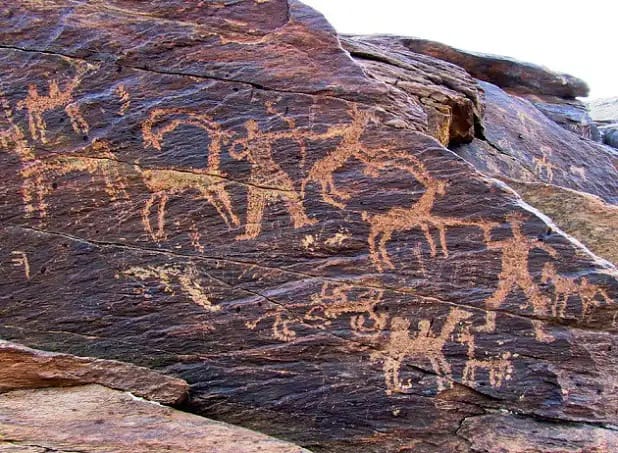
Golpayegan Petroglyphs, Iran
Perhaps it was in the stars when a deep freeze altered the climate in Central Europe. Glaciers began expanding as the last Ice Age descended about 40,000 years ago. The Aurignacian clan of homo sapiens, may have been the only humanoids who survived because they followed the star Orion toward the southwest and warmer climates along the Mediterranean. Surely they marked their routes.
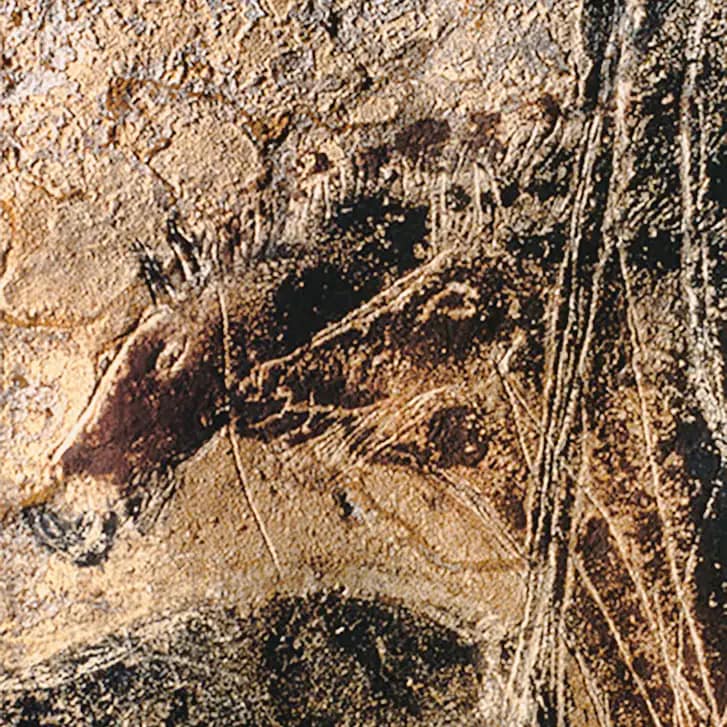
The Nave of the Great Black Cow, Lascaux
Aurignacians have been recognized as sophisticated ancient people who designed and made art works and artifacts. They are credited with designing the first art making tool, the burin. A flint tool, the burin was made for engraving deeper lines into stone surfaces with less effort.
Knowing how to use custom tools to transfer drawings, symbols and patterns on to stone surfaces required specific expertise.

Horse in frontal view, Chamber of the Felines, Lascaux
Few people are born with the will and innate skills to draw realistic pictures and enlarge them to mural size with no formal training. With reasonably good hand skills, interested persons learned by participating in a long apprenticeship program, in this case, brought to southern France by the Aurignacian culture and their legacy clans: the Gravettian (Gravette), the Solutrean (Solutré) and Magdalenian. Two of the world’s most remarkable painted and decorated caves are both located in southern France painted in Aurignacian styles.
Chauvet was active 36,000 to 20,000 years ago and Lascaux was active 20,000 to13,000 years ago. Both were intentionally or naturally closed by landslides.
At Chauvet cave, hundreds of generations of humans were satisfied with white plaster walls before some transcendental insight or happenstance occurred 36,000 years ago that prompted leaders to make an expensive decision. They commissioned a very large mural painting to decorate or defend a 20 Ft long wall in a very dark chamber.

Chauvet Cave – End chamber, detail
In order to make such a significant mural, the patrons had to rely on a team of designers, painters and artisans, who had previous experience making major mural paintings in dim environments. The team was not hired to generate ideas. Designers and artists were hired to illustrate the ideas of others. Patrons, politicians and priests invented a concept of a stirring almost surrealistic conclave of herds of ice age animals appearing in motion when lit with torch light. Some beasts even appear in perspective in places where few people would ever see them.

Negative hand (thin and small, probably that of a woman). Pont d’Arc cave (copy of the Chauvet Cave).
Decorations were used in public spaces. Engravings and drawings in red, black and white colors maybe with a dash of yellow ochre were placed near ceremonial cave entrances and along walls in large interior spaces. Red human hand prints have been found in both positive and negative styles near entrances. Archeologists demonstrated that hand prints were not used like a roll-call of attendees.
Many handprints at Chauvet have been identified as made by just a few individuals who seem to have been marking a route in red color. Human vision is limited to red colors in low light.
Ancient people would not have made handprints directly on to raw limestone walls. Unprimed rock surfaces were too abrasive. Broken skin was prone to infection. They applied colorants on walls prepared with gesso plaster. Ancient paint makers produced a muted array of iron reds formed into chunky palm sized lumps of clay-pigment mixtures for dry/damp applications. Spray paints were made from super finely ground red pigments disbursed through blow pipes and brushed smooth.
To make long smooth lines, they were drawn with lime paints mixed with carbon soot plus manganese black if available.
Brushes and dabbers dusted with calcium carbonate (calcite, marble dust) were used to mix grey colors on white gesso. Colorants were quickly absorbed into plaster layers so the picture didn’t flake off. Also the mural paintings in caves were re-painted and the lines sharpened up for over 15,000 years.
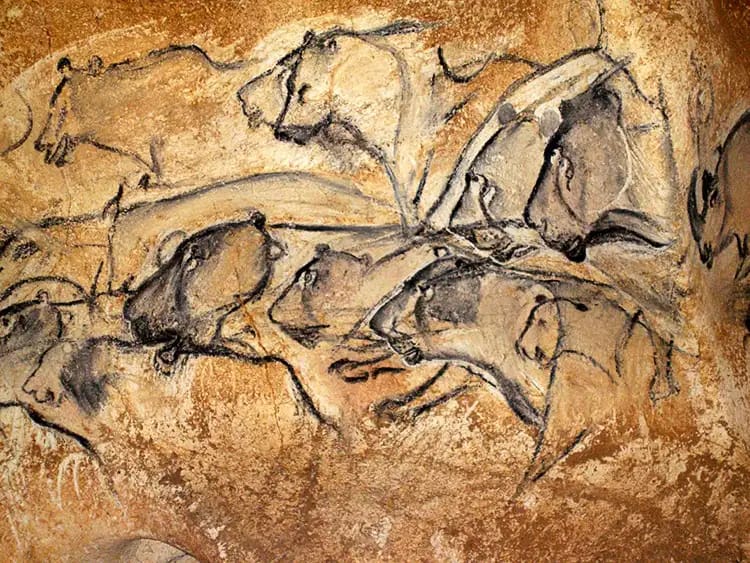
Visit Chauvet virtually
The paintings at Chauvet and Lascaux are once again sealed from the outside world but can be seen via technology.
The French Ministry of Culture and the French people offer an amazing tour online. Click on the lions to visit!