
A story about Jean Fouquet’s Lapis Madonna
A marble Madonna gazes down from the 15th century “Virgin & Child Surrounded by Angels,” an oil painting on panel in the Royal Museum of Fine Arts in Antwerp. Elegantly rendered, sublimely painted with three pigments coveted by painters for all times, this 560 year old art object is priceless. Why did a patron and painter commit a year’s worth of lapis blue pigment to a single painting rather than use it to illustrate hundreds of manuscripts?
I found the painter Fouquet in France early in the Renaissance. History picks up the story of an unusually talent young painter, one among freelance apprentices who traveled and worked in studios making religious art objects from Florence to Bruges mid-15th century. Jean Fouquet was born in Tours, France after 1406 and before 1420.
After comparing techniques and materials art historians suggest he apprenticed in the studio of the Bedford Masters, one of two prominent workshops producing illuminated manuscripts in Paris. Because they were also working in Paris, he may have associated with Netherlandish artists, including the Limbourgh brothers, master illuminators of the Northern style.
An image of Jan Van Eyck’s appears among Fouquet’s miniature paintings, some speculate that he spent time with Van Eyck’s studio in Bruges. Whether he or Van Eyck painted the first self portrait, Fouquet was among the first to paint miniature portraits, many of which were used for identification at border crossings.

Pages from the Book of Hours Bedford Master, British Library
Fouquet began his apprenticeship with master book illustrators just as literacy expanded and royals, wealthy merchants and the clergy wanted to display their prosperity by the quality of their libraries. Popular demand had increased during the Black Death because Christians decided to hold Mass services in private chapels away from crowds at church and exposure to disease. Since only nobles and elites were literate, most people preferred pictures which they found in intimately drawn and painted books.
The eyes were the gateway to the soul. From creation to cruxifixction, the stories were told in human form. Fouquet’s illuminations are described as unusual because his pictures looked natural rather than supernatural. Rather than the idealized the Holy Lands, he depicted local architecture and landscapes in his paintings. A master painter of tempera on parchment and paper, he was also an innovator in the development of oil glazing techniques. Fouquet was the master illuminators of his generation. Since the turn of the 20th century, art historians have considered him the greatest French painter of the 15h century.
By the time Fouquet was summoned to Rome to paint the portrait of Pope Eugenius IV circa 1437, he was an international art superstar. The painting, now lost, was remarkable to Vasari because the portrait was painted on linen canvas. As an illuminator, he may have preferred painting on flexible supports. Also as an itinerant painter, he may have made his paintings easy to transport.
After years on the road, Fouquet returned to France. He was recognized as a “supreme expert” and joined the court under the patronage of Etienne Chevalier, Secretary of State/Treasurer of the Court of Charles VII.
Association with a prominent and wealthy patron would have increased Fouquet’s access to the finest quality art materials. But his patron Chevalier would still have had to sign off on such lavish use of very expensive vermillion red and lapis blue in “Virgin & Child Surrounded by Angels.”
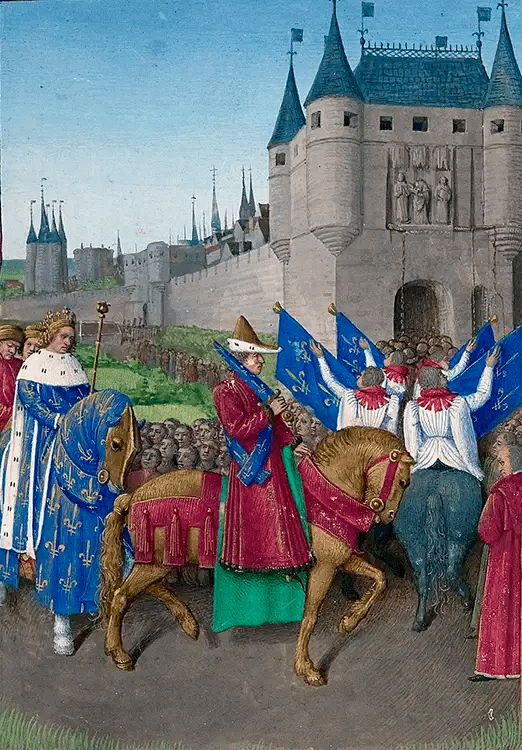
Entry of John II of France and Joan I of Auvergne into Paris after their coronation at Reims in 1350, later manuscript illumination by Jean Fouquet
In early Renaissance Europe, most bright colors were known to fade. Lightfast and bright Vermillion and Lapis both were indicators of a high level of status and wealth. Using, especially, lapis blue pigment in art work was a signal to the viewer to pay attention because only really good painters ever used lapis.
Fouquet continued to follow the new Italian trend and paint more more naturalistic portraits. Previously, medieval portraiture was not so much about what a person looked like but how a person wanted to be remembered as if in heaven. Instead of looking always to heaven, humanists started looking at each other. Instead of being idealized, people wanted to be recognized.

Portrait Agnès Sorel, favorite of the King of France, Charles VII
For his patron, he made a preparatory painting in a humanist style for a diptych which Chevalier was planning to give to the cathedral in his home town, Melun, near Paris. Historians did not note why Agnes Sorel was used a model for the Queen of Heaven. But one old stories mentioned Chevalier’s intention was to request the Blessed Mother to intercede on behalf of Agnes Sorel who had been sick.
But she looked good at the studio sitting where Fouquet painted his initial portrait of her easily recognizable as a real woman in the idealized traditional pose of the Virgin Mother, presenting one bare breast flowing with the milk of salvation. His limited palette of inexpensive earth colors, browns, blacks, Sienna and yellow ochre, a smidgen of white and a dash of earth red was a traditional sketching palette.
How could a painter with an international clientele and his sophisticated patron not have considered the effect of using the king’s mistress as a model for the Queen of Heaven? Perhaps, before they figured it out, Agnes Sorel died in 1450.
Certain mysteries surrounded her death. And like all who knew her, Chevalier must have been deeply saddened by her death. Perhaps she died of poisoning, Court intrigue or perhaps her lip color contained toxic mercuric sulfide Vermillion. The King believed she’d been poisoned, he was suspicious of his son and advisors. Secretary of State Chevalier had supposedly been among Agnes Sorel’s favorites at Court but few accounts point to a romantic alliance. King Charles placed great trust in Chevalier when he asked him to accompany his “Lady of Beaute” when she travelled. Etienne Chevalier is remembered as a man of sterling character as seen in the painting.

Melun Diptych, two panel oil painting depicting Etienne Chevalier with St. Stephen, and the Madonna lactans by the French court painter Jean Fouquet
Looking at the diptych, the paintings seem to have been caught out of synch just before the realism/idealism cross current energized the Renaissance. Two panels, two different styles, made with different color palettes. The color choices made for the “Chevalier” Panel appear more natural. The Infant Jesus points toward Chevalier’s very clean hands. A single mournful red angel looks out. The painting is an unqualified masterpiece.
So imagine the outrage of the Queen of France, Marie of Anjou, when she saw the painting depicting her husband’s dead mistress as the Queen of Heaven. After managing to endure the humiliation of her husband’s very public affair, she saw that painting and there is a hallway in history where her scream can still be heard. Fouquet made the fatal error of getting out front of his culture.
He assumed influencers at Court of France in 1450 were more sophisticated than they proved to be. Most French aristocrats were probably horrified at the the blasphemy of idealizing a commoner as the Queen of Heaven. Marie of Anjou prevailed. She never again saw that painting. And the painter was not promoted to Court Painter until after the death of Charles VII. The most accomplished artist of his time, Fouquet was made to wait a decade to gain his rightful position and income.

Etienne Chevalier and his Patron St Stephen Paying Homage to the Virgin and Child, by Jean Fouquet
In 1461, after Charles VII had died and he had retired from Court, Chevalier commissioned Fouquet to illustrate a prayer book, a very special edition of THE BOOK OF HOURS. This may be how the original paintings were visualized before Agnes Sorel died. Her face appeared in more than half the paintings in the book.
The Melun Diptych framed in dark blue velvet embroidered with silver and gold threads stayed with Chevalier until he died. In less than a year after his death, the diptych was taken apart and shipped out of France in 1475. But Chevalier made sure future viewers would know about Agnes Sorel. He affixed a label to the back of the diptych. Fouquet attached this medallion (self portrait) as his signature:
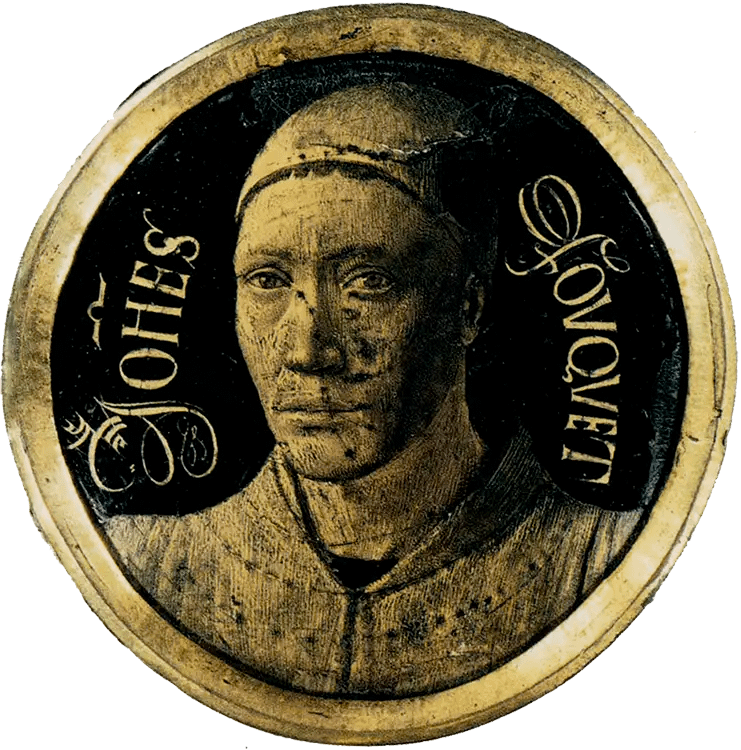
Jean Fouquet self portrait
The “Virgin & Child” panel was sent to Antwerp. The “Chevalier” panel went first to Frankfurt then to Berlin. Only twice have the panels hung together – in 1904 in Paris. In the Fall 2017 Agnes Sorel was briefly reunited with her admirers in Berlin.