
The fall of wall murals and rise of literature
The Bronze Age collapsed 3200 years ago. After storms of earthquakes during 50 traumatic years of planetary instability, the great palace civilizations of Mycenaeans, Minoans, Hittites and Assyrians shook to the ground. Volcano Thera erupted on Santorini and sent a tsunami to destroy the coast of Crete.
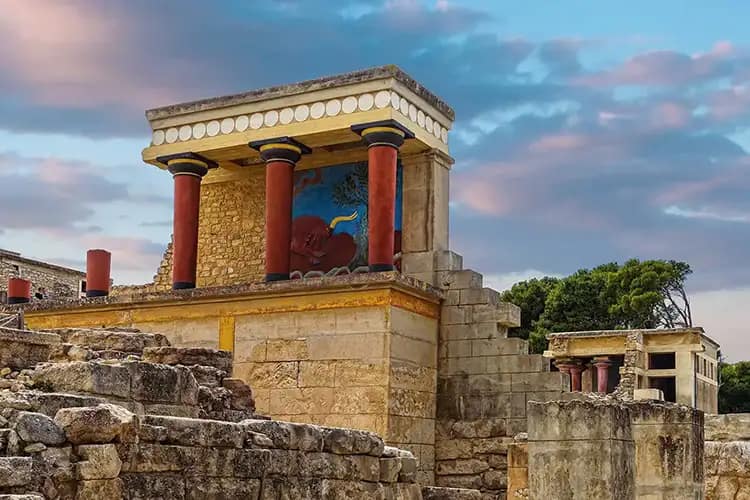
Palace of Knossos, Greece, 1,900 BCE
Sea people, warring clans of dispossessed marauders in boats, raided the ruins of Mediterranean cultures but did not bring down the Egyptian cities along the Nile. But their cities in Syria and Canaan were abandoned. Then for over a century, a mega-drought in Anatolia (Turkiye) caused crop failures and famine followed by years of plague.
Survivors of ancient empires also saw their art and architecture knocked down; their belief structures scattered and their temples in ruins. Most cities and their business systems were destroyed or deserted completely. Their trade routes, notably to acquire tin used to manufacture bronze, were disrupted then mostly lost.
The Mediterranean world entered the “ancient dark ages” during which the remaining people with enough education and experience had to maintain and re-establish key aspects of complicated cultures. The economies of the great palace cultures were replaced with trading among smaller city-states, the territorial kingdoms of the Iron Age.
Greece was among the cultures formed by witnesses of the Bronze Age collapse. Wall paintings had mostly fallen into rubble and were no longer able to fulfill the purpose of art, which according to Plato was to preserve memories. Too many had witnessed painting’s failure. A few hundred years after the collapse, Grecian intellectuals, philosophers, politicians and priests began to change the primary media for preserving cultural memory from painting and illustration to reading and writing. They created literature. What had been illustrated was to be written down using “Homeric Greek,” a revised alphabet fitted into a communications amalgam.
Using their alphabet, Greek cultural leaders invented literature as a better repository for their memories in the “Odyssey” and “Iliad.” Over millennia, storytellers had continuously intertwined myths about 12 gods, goddesses and their families who lived on Mt Olympus in a Bronze Age fortified palace complex. From their compound, gods and goddess terrorized humans constantly.
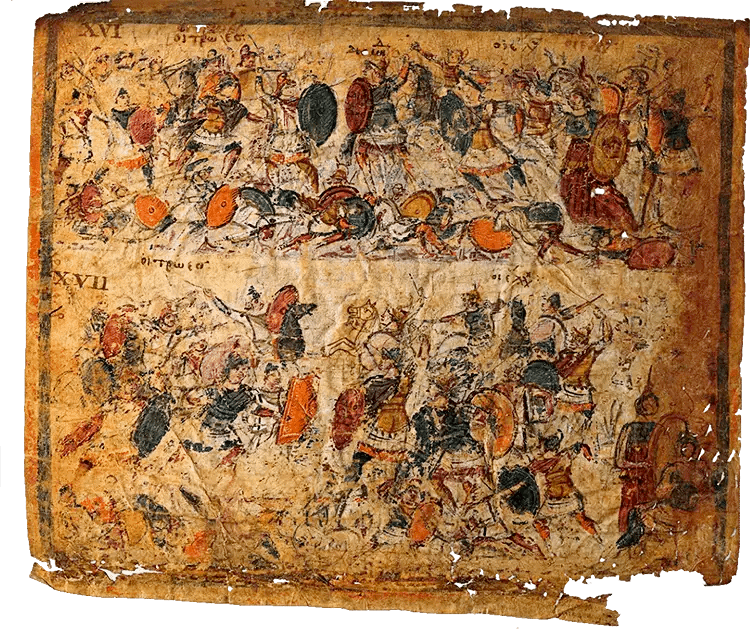
The Ambrosian Iliad, Image courtesy of The Ambrosiana Biblioteca
Surviving Greek paintings
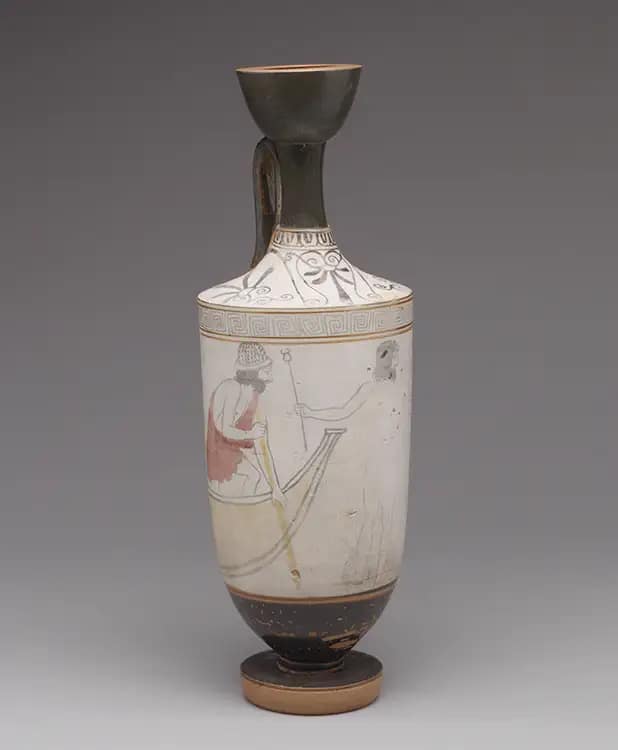
Attic white-ground lekythos. Charon the ferryman on his boat and Hermes with winged feet beckoning a youth. Ca. 450 B.C. © The Metropolitan Museum of Art.
Grecians were afraid of ghosts. Immediately upon death, a relative had to slip a coin on to the tongue of the deceased so the soul had the fare to pay the ferryman. Otherwise Charon would leave a poor, forgotten psyche behind on the living side of the river, waiting around haunting relatives who forgot the rituals.
Not remembering was the gateway sin that opened the soul to all other sins; and being forgotten meant the end of existence. So relatives, who did not want a shade knocking in the night, might have hired an illustrator to make a small portrait as a commemorative to be been placed in a wall frame as a prompt to remember. One who was remembered by the living had a better chance to find a place in paradise.
A few surviving votive paintings called the Pitsa Panels, 12” X 6” (ratio 2:1) painted about 2500 years ago were found in a cave tomb near Corinthia. The paintings were made with materials and techniques similar to those used by Minoans and Egyptians except they were painted on thin (½”) oven cured gessoed pine panels as sole support. Artists used buon and secco fresco techniques with lime paints and colorants like Egyptian blue, cinnabar red, red iron oxide, yellow ochre and carbon and manganese black. Realgar orange and an array of organic colorants from saffron to red madder roots, were added to regional palettes.

Ritual dance, painting on wood panel, from Pitsa Cave, second half of the 6th c. B.C.
The purpose of painting was no longer to hold memories generation to generation but to hold the memory of deceased loved one only until the conclusion of the funerary rituals. Greek painters may have made as many paintings as those in other ancient cultures but longevity of the object was not important because the pictures were never intended to be saved.

Horsemen Temple Relief from Parthenon Sculptures, Athens, Greece, 438BC-432BC

Claw Chisel for sculpting marble
Rather than wall murals seems ancient Greek patrons preferred bas- reliefs, sculptures and stele as tomb markers. 2500 years ago artists and artisans had no power tools to polish marble surfaces. Marble is a compressed form of limestone. After sculpting with punch & mallet and various chisels, carved surfaces would have to be sanded by hand to a rough standard. To smooth out rough surfaces, artisans could have applied gesso, layers of lime plaster on top of the carved marble (marble and lime plaster have the same chemical composition.)
Technically, colors would have been applied on to traditional gesso rather than directly on to marble surfaces.
Lime wash (white wash) paints and dyes would have been blended into rosy skin tones and red blushed lips at least. To finish and seal the surface, a layer of an emulsified punic wax mixture similar to ones used in for interiors like Egyptian tombs would have been rubbed on. Using candles and soft cloths, artisans buffed the surface before completely cool to create a soft sheen. Resin varnish might have been added to harden the wax coating and preserve the colors.
Scientific enthusiasm for how many different colors Greek artists and artisans used on their sculptures seems to have faded toward a more nuanced color vision for Greek culture. Some historians doubt their sculptures were brightly colored. Designers and artists chose a muted primary color scheme of natural mineral pigments in plaster white, yellow and red plus carbon blacks because they wanted the marble statue to look alive. Traces of minium red and red lead suggest skin and lips were tinted with a rosy glow. Some sculptures may have been ritually painted for generations. Red symbolized transitions in the cycle of life.
In the entire history of art, ancient Greeks seem to be the only sculptors that ruled the market place commanding highest wages and best materials. The Greeks were so highly regarded for the quality of their sculptures that Roman artists and artisans made copies of them which is fortunate because few authentic Greek sculptures can still be seen.
Header image: Map of Late Bronze Age Collapse