
Cimabue in purgatory with Dante 13thC
By the end of the 13thC, the writings of Aristotle and Plato had became required reading in Latin translations for university students throughout Europe. Even though religious clerics and their bishops had tried to control the expansion of literacy since 1088, when the University at Bologna was organized, they could not stop secular universities from being established in across Europe.
Prevailing thought turned away from Roman cultural and the Christian Church toward ancient Greek culture, and toward even more ancient influences from Egypt. Literacy increased. Over the next hundred years academics and scholastics wrestled with how to balance religious and secular lessons. But the schism between studies on divine nature and human nature widened and academics organized their guilds into universities ready to meet demand for education beyond the catechism.

The School of Athens, by Raphael, 1509–1511, Fresco, Apostolic Palace, Vatican City
Royals, elites and professionals wanted more educated, civilized sons to take places in their expanding businesses after the Crusades opened trade routes. Parents expected their sons to read and write plus add and subtract, which are business skills. Parents probably did not expect their sons to become radicalized by ancient ideas. In their classrooms and coffeehouses, young people and their professors wondered: can human beings attain happiness through their own powers. Can humans find happiness in this earthly life? Aristotle thought it possible. But the clerics thought not. The Inquisition started in 1233.
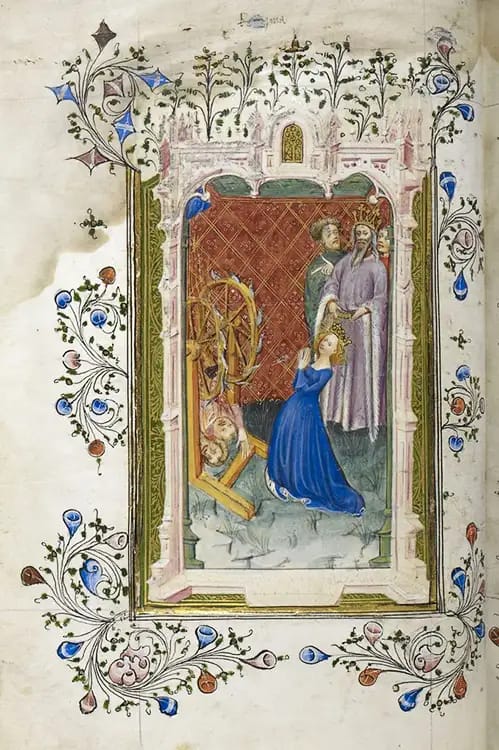
Miniature of St Catherine before the wheel, with the Emperor Maxentius in the background, from the Beaufort/Beauchamp Hours, England (London) and Netherlands (Bruges), 1401 – c. 1500
Conversations about planetary consciousness continued in private correspondence among intellectuals; and trade books became sources of literary entertainment like “The Song of Roland.” Not only scholastics and academics, book makers and manuscript illustrators were dealing with new clients who wanted more action-oriented books featuring stories about St. Catherine breaking the wheel instead of just standing beside it.
Regardless of clients’ preferences, books could only be as large as the physical dimension of the parchment folio, which is a sheet folded. Limited by physical dimensions, designers, painters and artisans found ways to gain more pictorial space by expanding inside the picture frame.
They invented a system to draw linear perspective. Linear perspective is a way to create an illusion of depth on a flat service. They learned how to draw a vanishing point which human eyes read as “depth.” Their goal was to make a world that did not look flat and to make illustrations look natural.
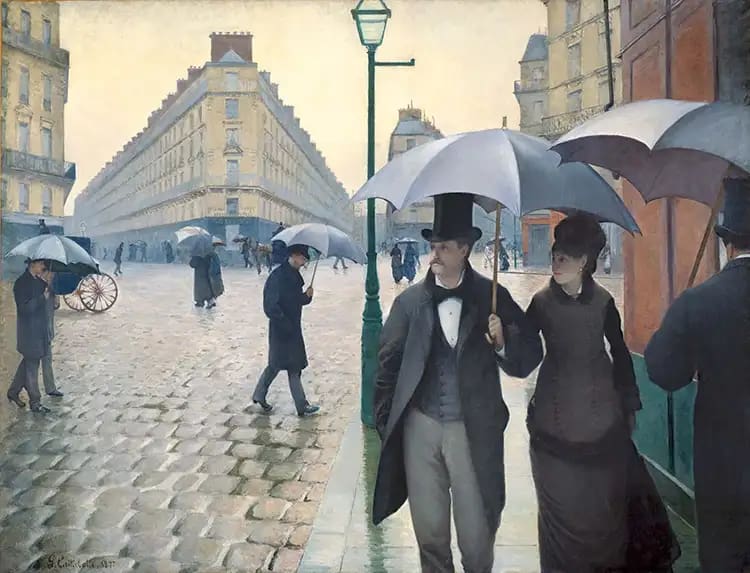
Rainy Day, Paris Street, Gustave Caillebotte, 1877

Dante, Andrea del Castagnoc.1450, Uffizi Gallery
Adding a vanishing line was radical but the hard part of the change was breaking the ancient tradition that determined where large figures were placed in the scene. To make a drawing in perspective, the small figures had to be placed further away and larger ones closer to viewers. Traditionally, the size of the figures in a drawing or painting was symbolic. A large figure placed anywhere in a scene was more important than a small one. Congregants would have recognized the largest figures in paintings were donors in the guise of saints. Instead of being recognized by size, donors became recognizable.
Among the most recognizable influencers in 14thC was the Florentine intellectual Dante Alighieri (1265 – 1321), a local politician, also a humanist involved in discussions on the autonomy of human reason. Dante focused his creative literary work on exploring human nature as in “The Divine Comedy.” He continues to be known as one among a few human beings who dared a journey through the underworld and returned.
“The Divine Comedy” evolved from a literary tradition of “philosophical poetry” which he radicalized by choosing to write in an Italian vernacular rather than write in Latin, the academic language of his time. Like a later-day Orpheus, he advanced with his guides through an intermix of Greco-Roman mysteries and Christian mysterians. Using a complex narrative device Dante wove his philosophical and psychological theories on human nature into stories that could be read, spoken and heard by everyone.

La Carte de l’Enfer, Sandro Botticelli

Portrait of Cimabue, Italian painter and designer of mosaics,
by Nicolas de Larmessin, 1682.
In Florence, Dante was a literary star at time when performance art was a dominant force in Florentine culture. He probably was acquainted with most artists who lived in Florence (then a city of 120,000) like the painter Cimabue, a prominent studio master 20 years his senior. Cimabue may even have heard Dante read his poetry in person.
Acknowledged as a master painter during his life time, Cimabue’s biography was the first one featured in ‘Lives of the Most Eminent Italian Painters, Sculptors and Architects'(1550) by George Vasari.
Known by his nickname which meant “bullheaded,” Cimabue was also recognized as an expert at integrating new techniques into his paintings. He deepened illusions of naturalism by adjusting proportion and added shading to enhance a sense of depth. While not complimentary, his nickname was one that recognized his complete commitment to making exquisite art works of excellent quality. He was known to destroy paintings he considered of lesser quality. Some might say that’s a sin of pride but his high standards set him and his workshop associates apart from the mostly anonymous painters of his era.
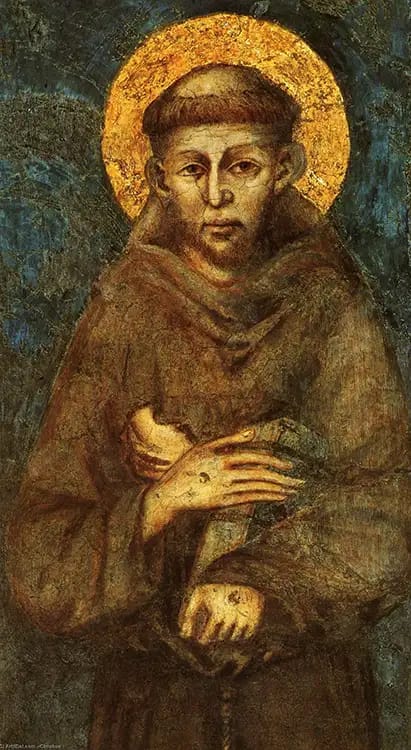
Saint Francis of Assisi (detail), Cimabue
Cimabue (Chee-MA-boo-ya) is considered the last great Italian painter in the Byzantine tradition. Born Bencivieni di Pepo after 1240, he was a true visionary who painted people realistically and recognizably.
Cimabue was master of both Byzantine and Roman Christian styles which he fused into his masterpiece “Maesta” (Majesty) paintings featuring the Virgin & Child surrounded by angels. His Majesty paintings were made by a large team of experts under his supervision, using egg tempera paints modified with oil varnish and beeswax painted on bright embossed golden grounds. While his human subjects look more natural, what does not look natural is the sheer size. A few of Cimabue’s paintings are as large as 15 FT X 9 FT and still on display in Ufitzi Gallery in Florence 750 years after they were made.

Santa Trinita Maesta Painting by Cimabue
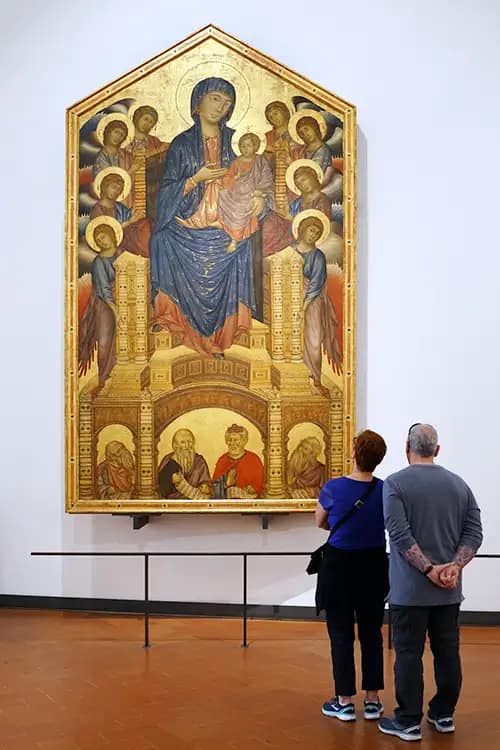
Santa Trinita Maesta Painting by Cimabue as installed in the Uffizi, Florence, Italy
In addition to his place in late Medieval art history, Cimabue is known as one of only two painters mentioned in Dante’s “Divine Comedy.” In “Purgatorio” Canto XI, Cimabue was found in purgatory for the sin of pride. Maybe Dante carried a grudge. After all Cimabue never did paint his portrait. More likely, Cimabue’s blended Byzantine/Roman painting style simply went out of style at the beginning of the Renaissance.
“O vanity of human powers,
how briefly lasts the crowning green of glory,
unless an age of darkness follows!
In painting Cimabue thought he held
the field, and now it’s Giotto they acclaim!”
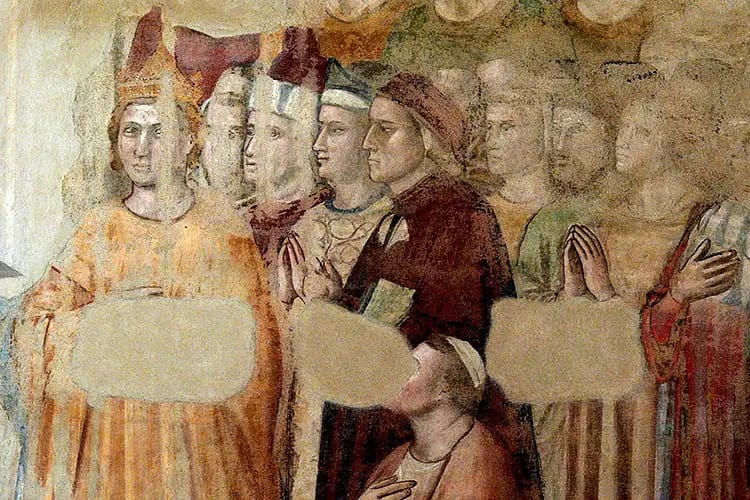
Fresco of Dante by Giotto, now in the Museo Bargello.
Giotto (Giotto di Bondone 1267 – 1337) was the other master painter mentioned by Dante and he did paint Dante’s portrait in a fresco in Chapel of the Magdalene in the Palazzo of the Podestà in Florence. And Giotto did eclipse Cimabue, his former employer, as Dante inferred. He further expanded the picture frame with 3D effects and he continued to develop the humanism of his visionary master.
Giotto built a large family and major art making studio during the early 14thC and prospered. During his career, Giotto and the painters he trained in his Florentine workshop created frescos on churches throughout Italy, including in the south at the Cathedral of St. Catherine of Alexandria in Gallantin (Puglia).
Header image: La commedia illumina Firenze, on the wall of Florence Cathedral, Domenico di Michelino