
Storytelling is the key
Whether on wood panels, as icons or on stone walls, storytelling is a key reason Christians made murals and illustrated books. Visual arts played an essential role in communications among multi-ethnic congregations, some with low literacy rates. Wall murals and messages would have been visible in rooms where Christians gathered together discretely.
To communicate with a group without a common language, church leaders decided to break with Biblical traditions and create a visual art making system to inspire the faithful. After a long process of discussion and reflection, an agreement was reached about the meanings associated with Christianity. Designers integrated the new symbols with images to evoke a shared story. Artists and artisans painted the images into pictures with quick mezzo fresco techniques and fluid paints on to a plaster wall. The materials and technique made repainting walls easy. Better quality wall murals were made using fresco paintings techniques both buon (true) and secco (dry) techniques.
Romanesque architecture
Romanesque architecture can be described as an amalgam of Roman construction methods and Gothic (Arian) Christian aesthetics. The style evolved as an ecclesiastical standard for developers after Christians started building churches aboveground. Throughout the long fall of the Roman Empire and the rise of Muhammad, Christians sects struggled to settle on dogma. While the Byzantine church did not reconcile with the Roman Christians, the politics of religion did not deter Christian congregations from hiring architects and designers to build and decorate chapels, churches, cathedrals and basilicas.
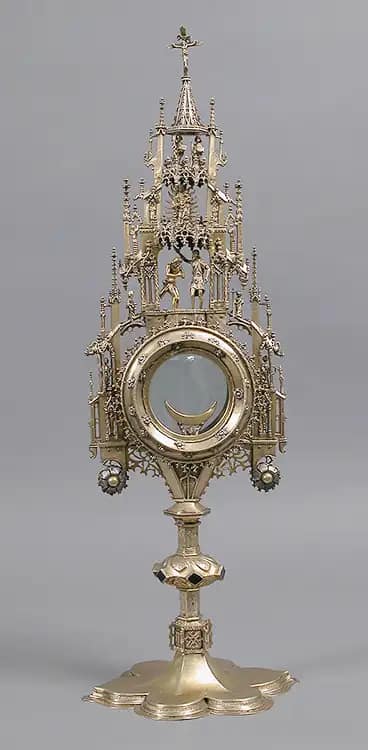
By the turn of the first millennium, thousands of golden art objects like chalices, reliquaries, statues and altarpieces had been made. Christians enthusiastically displayed their faith. Churches were decorated with patterns and frescoed stories about redemption and salvation. Like the Romans, Latin Christians used a sequence of frescoes to illustrate chapters of a story usually placed in chronological order along a church wall.

Otranto Cathedral, Italy
Artists and artisans, who made the murals, relied on religious commissions until royals, sophisticates and business owners acquired an interest in the art making business during the Medieval era. They commissioned art works to donate to their local churches, also for their personal chapels.
There was enough business so that artists and artisans could separate into fine art making guilds and industrial guilds working mostly in construction. Fine art making required finer hand skills, which meant more training and much more practice. Through their apprenticeship programs, art making studios handled the demand for painters, illustrators and others working to make buildings beautiful for the glory of God.
Rise of icon painting on wood
While Roman Christians were making wall murals for congregations of believers to observe together, Orthodox (Byzantine) Christians were making more intimate art works for a more internalized visual art experience. Making icons was a spiritual, perhaps transcendental experience. Artists, often members of religious orders, prepared to paint by fasting and praying for a way into a sacred space where forms and symbols revealed images from heaven.
An icon has been defined as something lifeless that was “soul’ed” with God’s grace. Icons are made to inspire something akin to holiness. To achieve the effect, painters applied egg tempera colors and multiple thin layers of oil varnish until the paintings glowed with light trapped inside layers of transparent oil. While late medieval painters embraced the materials and techniques, the transcendental aspect of art making was rarely explored in Western Art until mid 19thC.

9th century the icon of the Theotokos Blachernitissa, also called “Our Lady of the Sign” Constantinople.
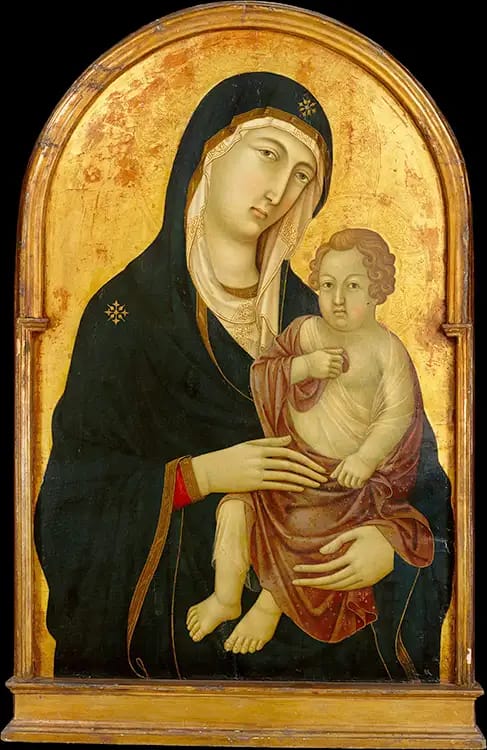
Madonna and Child, Workshop of Ugolino da Siena (Ugolino di Nerio) Italian, ca. 1325
Painting off the walls
In the Medieval era, except for shrines and crucifixes, painted altars were not preferred because painted altars lacked status and looked cheap. Clergy and royals preferred to commission richly illuminated manuscripts with designer bindings and golden edges. That changed when paintings became portable. Practically speaking, paintings on wood panels became collectible because they could be moved around.
Wall murals made to represent episodes in a story were painted on stone walls to control the sequence. Like the “Stations of the Cross,” the pictures were designed to be viewed in a specific order. While some wood panels were bolted together, most were separated into single panels and the sequential stories were forgotten.
Visual story telling relied on crisply drawn lines. While Medieval painters embraced wood panels and golden grounds, they did not change their primary painting media. Perhaps patrons did not like the look of glowing icons. The glow tended to make fuzzy lines when compared to the clear lines made by tempera paints. The story was more important than the way the story made people feel. Italian clients especially clerical patrons preferred the look of pictures with well defined lines until after the Renaissance.
Facing the wall
Painting on panel became even more popular in the 13thC. A new opportunity for artists and artisans became available after the pope changed the position of the priest during mass service. The altar table was moved from the center to against the east wall. Instead of facing their congregations, priests faced the altar with their backs to parishioners. This change opened up new real estate for “reredos.” Reredos are the usually painted always ornamental screens designed to rise up on the wall above the altar in most Gothic and Renaissance churches.
Instead of looking at the back side of priests, parishioners’ eyes ascended to the beauty of the heavenly realms. Most reredos were constructed and assembled from mixed-media often carved into relief to heighten the dramatic effect. Many assemblages included tempera paintings on thin gessoed panels coated with wax varnish to protect against soot and residue from incense.


Two Christians Before the Judges, Niccolo Semitecolo
Price of Gold
By the end of 14thC, most art workshops were making paintings on gessoed wood panels but only a few were still making paintings on golden backgrounds. That changed due to expense. For more than a hundred years, cheap African gold flooded art making workshops at a discount rate. By the end of the century, the price of gold increased to more historic levels. When the price of gold was finally too high, art making workshops opted to simplify the painting process and skip a step. They painted directly on the gesso ground, which were bright and significantly easier to prepare but not shiny.
Header image: Madonna and Child with Saints James Major and John the Evangelist, altarpiece by Sano di Pietro