
It’s human nature to enliven space with colors, designs and pictures. To meet demand, artists and artisans have prepared painting surfaces with lime and gypsum plasters for thousands of years. Wall murals can be made with all visual and most graphic art media. Art historians estimate only about .01% of wall murals are still visible. The few survivors of the test of time are frescoes, which demonstrate the power of the fresco binding system to endure so long as nobody else wants the wall space.
The oldest word associated with mural painting is “murus” from Old Latin for “wall.” Throughout the Mediterran, Africa, Middle East, India and Asia, murals in civic centers and public places were made using fluid, inexpensive paints with glue-based binders. The most common technique was to paint images and messages on top of dry or only slightly moist plaster layers instead of using the more complicated and expensive fresco technique.
Public wall murals were made to catch the attention of people passing by, not to take a place in cultural history.
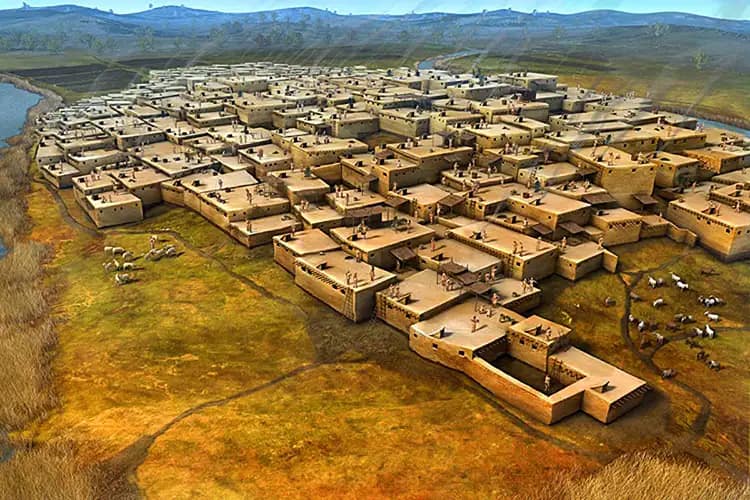
A recreation of Neolithic Çatalhöyük, Central Turkey, around 6,500 BCE.
Using mural paintings for interior design seems to have originated with the Natufian people after the Younger Dryas climate emergency about 11,000 years ago.
Buried in Anatolia (central Türkiye) archeologists uncovered a few murals painted on exterior walls in the city of Catalhuyuk. More murals were found on interior walls.
As many as 8000 people lived in multi-storied apartments constructed with the same building materials used to construct rock shelters, including calcium carbonate (marble dust, chalk), gypsum and lime.
And those same materials are still being mined from the earth and used to make interior walls for new construction.
Roughly made impasto plaster was used for exterior finishes except for walls prepared for pictures. Stucco was a smoother, more water resistance plaster, mixed from lime putty, animal tallow and vegetable oil. Interior rooms were constructed using lath and plaster finished with plaster layers. The available house paint was fluid “white wash,” or lime paints made from calcium carbonate (marble dust) mixed with waste water from lime production used to brightened wall surfaces.

Wall painting of spring landscape from Akrotiri shrine
As human population expanded and demands for housing increased, innovations lead to process improvements in paint and plaster manufacturing. Grinding pigments required the same technology as grinding wheat into coarse flour. Over millennia, artists and artisans have used hundreds of methods from all industries to refine raw colorants from the earth into fine artists’ paints to make illuminations, illustration and decorations on walls some of which can still be seen.
In ancient urban trading capitals where people of many countries mingled, the Mesopotamian elite invented a fresco wall finish using “Venezia Stucco” as an alternative display of wealth for iconoclastic guests. Those guests would have only seen marvelously illuminated walls infused with subtle colors, depicting no images which might offend. The purpose of the wall art was to enhance the ambiance of prosperity not inspire conversation. But most people preferred to see pictures and tell stories about a shared memory.
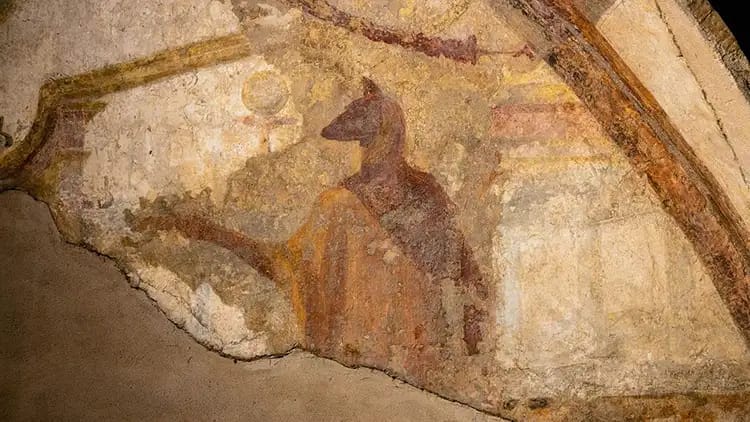
Fresco of Anubis, the Egyptian god of death and the afterlife. Baths of Caracalla, 2nd – 3rd century CE
Commissioning a commemorative fresco was expensive. The process involved the work of designers, illustrators, painters and artisans who worked for months to complete big projects. Ancient people designed frescoes to stay in place and serve a purpose beyond decoration. Most ancient art works were found in tombs, placed away from the damage done by daily life and serial ownership.
While many colorants, pigments and dyes, were package for wall murals, only a limited palette was available because so few colorants were compatible with the alkaline lime/water binder. “Lime proof” pigments were mostly refined from iron oxide earth pigments plus charcoal black + manganese black and various combinations of white pigments. Colorants made from organic materials refined from gall nuts, stems and tubers, for example, were not compatible.
Pigments were mixed with lime water into viscosities from slurry to soft paste depending on how designers wanted the pictures to look. Designers and painters worked out color schemes and studied absorption rates on small wood sample panels, prepared with the same plaster layers as the wall. The designer could show client how the colors would look when dried. These sample panels were also drawn and painted as a guide for artisans who would transfer the design to the wall. When the job was finished, the wood panels would have been sanded down and another plaster layer was added. This is the origin of “gesso.”

Fresco of Saint Peter, Cathedral of Otranto, Italy
Once the wall had been prepared with a stucco layer, three additional plaster layers from gritty to smooth would have been applied. Depending on temperature and humidity, layers were left to dry for 10 days between applications. An additional layer of very fluid paint made from lime water mixed with calcium carbonate with/without colorants was used to smooth the surface and adjust the absorption rate of the plaster. With luck that layer would have been good enough to serve as an intanaco or drawing layer. To transfer the design, artisans incised the lines of the picture into the damp plaster surface using maroon pigment sticks made from hematite + clay which left red streaks in white plaster and cast a shadow.
Colorants for wall murals were “distemper” paints from Old Latin “to soften” as in softening limestones into putty. The fluid paints were made thick enough to spread evenly to a wet edge and thin enough to be quickly absorbed. Using paints that were too fluid made blurry lines because paints spread too far under the design lines and blurred the boundaries. Each color layer was affected by how much paint was absorbed into underlying layers. For wetter walls, thicker paints were made with additives like glues, oil varnish and beeswax.

Frescos within the Church of Saint Peter, Cathedral of Otranto, Italy
The additives were applied with the final layer to slow down absorption and maintain sharper lines and/or balance the colors. Over-painting with fresco paints was discouraged because it made murals looked murky. Fresco colors tend to dry lighter than they looked when first applied. For painters, there were no do-overs and no color blending. Once mixed with water, the chemical reaction between carbon dioxide and lime started inside air pockets which were trapped in gritty plaster layers and started to dry. Plaster transformed back into limestone but this time with pictures sealed in stone.