
Flowering of the Renaissance
The flowering of the Renaissance was rooted in the years before the Black Plague. Artists’ practices were already changing with the introduction of oil varnish and panel painting from Constantinople. Then everything stopped during the plague years in mid-14thC. About half the people in Florence died.
About 50 years later, Florence was back in business. Fewer workers were left behind. For the first time in human history, the serf class was eliminated and literacy advanced. Everybody went back to work for higher wages. And a powerful influential merchant class was forming. After supplying the Crusaders for hundreds of years, Florentine and Venetian traders had grown richer and powerful enough to elevate their social status above the guild class and into the middle class.
Class struggle
The formal class structure of Medieval Europe loosened as more sons of the merchant class attended university to learn the seven liberal arts plus mathematics with a goal of attaining upper class status. Only with upper class status would they be recognized as individuals had learned how to think abstractly. Imagination came naturally but the ability to think abstractly was a learned skill.
The emerging professional class of developers, bankers, lawyers and CPAs organized “academies” more like salons where men could meet to discuss ancient history, business and politics. The academies were in competition with the Roman Church for talent. Most art making workshops specialized in making religious art works and they were booked with new commissions for inspirational portraits of saints to illuminated the walls of new churches, convents and monasteries built for those left behind after the plague with no families.
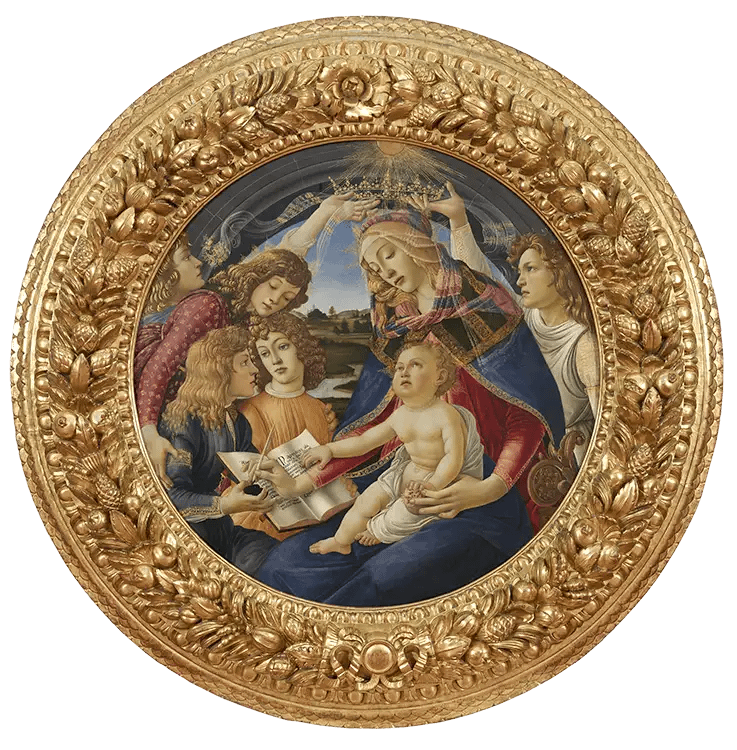
Virgin and Child, and Angels (Madonna of the Magnificat) Sandro Botticelli (Florence 1445 -1510)
Florence as an art destination
Rather than compete with the church, the academies hired international architects, designers and artists, some of whom moved to Florence for steady work. Some academicians contributed a portion of their accumulated and consolidated fortunes to the revitalization and beautification of Florence. A city of 100,000 people, Florence supported 40 art making workshops full of painters working in multiple media, paint and ink makers, stone and glass cutters; jewelers, goldsmiths, engravers and alchemists. Business was booming.
Art making workshops would have been hiring so more opportunities to apprentice with master painters opened for young men about 13 with good hand skills like Sandro Botticelli (1445 to 1510). By age 20, the best painters were either working for a major workshop or managing their own shop. Regardless of their skill levels or education, painters worked in the building trades; and were considered “mechanical” artists. They were guild class. Regardless of personal achievement and prosperity, guild class applicants would not have been considered capable of thinking abstractly. They were not included on design teams or eligible for membership in the academies. That ancient prejudice was finally challenged and defeated by the Renaissance art stars.
Attracted by Renaissance art starts, clients and collectors traveled to Florence to visit art making workshops to commission a painting, shop fashion trends and see the latest shows. Depending on status, patrons would meet with a master painter or a sales associate to look at paintings to figure out what a client expected to see. Most wanted to see the signature look of a master painter to impress their guests and business associated. Adding a family crest or a crowd scene increased the price.
Botticelli’s personal style
Sandro Botticelli was an apprentice who became a master painter at the tipping point between monastic Medieval and secular Renaissance styles. Originally apprenticed to a goldsmith, Botticelli’s sketches caught the eye of Fra Filippo Lippi whose studio he joined as a fresco painter.
From long association with Fra Filippo Lippi’s studio, Botticelli learned how to set a scene in linear perspective and is said to have developed a fanciful personal style.
Botticelli opened his own art making workshop in 1470 where his tempera colors were custom mixed with a fine alabaster powder to make paints into softer looking tints (paint color + white). The sensuous light surfaces accentuated Botticelli’s dramatic use of dark lines to strike a balance between darkness and lightness.
Egg tempera was his primary media for illustration and painting. The look of tempera can be recognized by linear brush marks laid down in a single stroke, as the paints set up too quickly to blend.

Sandro Botticelli, Adoration of the Magi (detail)

The Last Communion of Saint Jerome (detail) Botticelli
Early Renaissance painting studios were experimenting with artists’ colors formulated to blend into thicker layers and smoother surfaces. Tempera grassa was a precursor to oil paints, essentially egg tempera binder enriched with oil varnish (linseed oil and pine resin varnish). Also oil varnish was mixed with colors into thin transparent glazes to add dimension to paintings.
By the time Botticelli painted “Primavera” in late 15thC, adding oil glazes was standard practice.
Medieval conscience

La Primavera, Sandro Botticelli (Florence 1445 -1510)
For 20 years his workshop produced paintings and artifacts primarily for the Medici family in multiple media. He enjoyed the of personal patronage of Lorenzo di Pierfrancesco de Medici, a banker and poet, who commissioned a large painting of “Birth of Venus” as a wedding gift for his nephew about 1485. By then salacious paintings had become acceptable for display in private clubs. This was commission for a bedroom featuring Greek mythology and naked ladies. In ancient Greek and Roman cultures except for Aphrodite, women were portrayed clothed. Styles change. Even for Medieval Catholics, business was business.
There is no indication that Medici family intended to exhibit “Birth of Venus” anywhere other than the bedroom of Lorenzo’s nephew. The painting was stored or displayed in various Medici family homes until the 1800s. (The first public exhibition of the painting was in 1850s at the Galleries of the Academy in Florence.)

The Annunciation
Botticelli (Alessandro di Mariano Filipepi)
Evidently, Botticelli’s medieval conscience caught up with his secular self. He heard the call for Christian renewal. Any pictures of naked ladies left in studio were tossed into Savonarola’s Bonfire of Vanities in 1497. Due to political upheaval, Botticelli’s patrons were exiled from Florence, and he was caught in changing times. He turned away from his secular paintings and returned to his Medieval influences.
Header image: Adoration of the Magi Novella (detail), Uffizi Gallery, Florence, Italy