
How humans see color
Human beings have been changing colors on skin, textiles, walls and table tops for hundreds of thousands of years. Colors have been used to highlight symbolic and decorative elements in communication media like painting, drawing and printmaking. For over 30,000 years artists and artisans have been well aware of which colorants make permanent marks. Iron red colors are the only ones visible to humans in low light.


Bioluminescent Tide in La Jolla
Human eyes receive frequencies from three sources of light: transmitted light, which streams through transparent media like air, water and paint binder until it bounces off an opaque surface like gesso. Reflected light is bounce light reflected back to the eyes. The third form of light humans see is luminescence, a phenomenon of matter to absorb invisible frequencies then emit them as visible colors that glow in the dark.
Hue, color and frequencies
Using a prism or rain shower, light can be dispersed into six million color frequencies organized into six hues. “Hue” and “color” are not interchangeable words.
A HUE is a bandwidth of frequencies in the human visual spectrum.
A COLOR is a single frequency inside a bandwidth. Wavelength is measured in meters (nm – nanometers). The speed of a wavelength may change, but its color frequency does not. Frequency determines the color. Frequency is measured in hertz at 1 cycle per second.
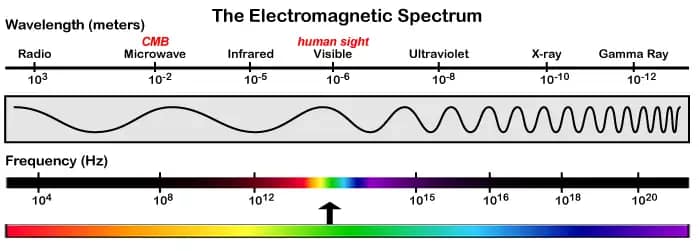
At color frequencies about 400 THz (Terahertz = 1,000,000,000,000 cycles per second) humans begin to see red colors. The human visual spectrum extends from longer wavelength red/maroon colors to ultra violet short wave colors that easily scatter. At the edge of human vision is luminescence.
The human eye
Eyes work on the same principles as rainbows. Light travels through air until meeting the cornea which adjusts the speed of light and its angle of refraction, which bends light and slows it down. Light is refracted again by the transparent vitreous fluid in the chamber of the eyeball then focused on the retina. The retina is considered part of the brain because it develops from the embryonic forebrain. And the retina houses the photoreceptors – rods and cones, which are embedded in the brain like spark plugs in an engine.

Drawing showing a section through the human eye with schematic enlargement of the retina
Rods initiate vision when even a single photon of light enters an eye. Rods are rod-shaped, the original mammalian photoreceptors that “see” the relative value between brightness and darkness. Essential for vision in low light situations, rods work best at twilight and dawn. Hunters rely on this value-based vision to spot movement along the horizon.
Cones are cone-shaped photoreceptors with the potential to receive color frequencies from long wavelengths (red hue) about 780 nm to short wave (violet hue) from about 380 nm.
Cones work best in full sun light when humans need to see fine details and subtle variations in color.

In the middle of the human visual spectrum is the spacious green hue. While humans have the potential to see six million colors, we see significantly more colors in the green hue than any other. Being able to see colors in the green hue was critical for survival. Where green can be seen, human can find water and in season ripe fruit.
Visual science and visual art
While searching for new ways to explore color science with visual artists, I found a link to Webvision at the University of Utah and the work of Dr. Helga Kolb. She skillfully explains complex chemical reactions like how human eyes stay cool while constantly being bombarded by electromagnetic energy; and other mysteries. Dr. Kolb is a visual artist as well as a vision scientist.

Helga Kolb – Grand Canyon