
Ancient Egyptian artists and artisans used colors symbolically. Red symbolized natural energy and blue symbolized supernatural energy. Through thousands of years of art history, blue colors have come in and out of style except during the Egyptian dynasties. For pharaohs, blue was always in style. Blue symbolized birth, death and re-birth also sky and heaven.

Blue glazed composition chalice in the form of a blue lotus. Egypt, 21st Dynasty, British Museum
As a premium status symbol, lapis lazuli blue represented all that was pure and rare. The pigment was non-reactive but separating the blue color rocks from stones was hard work. But grinding the Philosopher’s stone was trickier. Grind too lightly, the pigment is coarse, chunky, and too pale a blue color. Grind down too far, and the blue color goes forever grey. Rock, not mineral, lapis is the most rare, true blue color mined from the earth. Afghans traded lapis rocks and pigment for 6000 years along the silk road. Thousands of lapis statues and seals have been found in royal Sumerian burial tombs at UR where lapis was considered a precious stone. For the Egyptians, the chemical composition of the pigment was of much less concern than the color.

The Goddess Isis and her Son Horus, Ptolemaic Period, 332–30 B.C. ©Metropolitan Museum of Art
All blue colors were so deeply embedded in the cosmology of ancient Egyptians that when they could not buy it because trade routes were blocked; or find it in their own mines, they manufactured it. To guarantee of a steady supply of lapis color blue, Egyptian chemists became the first pigment manufacturers in Western history. To make Egyptian Blue, very specific amounts of fine white sand, natron, containing baking soda and salt, lime (calcium hydroxide) and copper metal shavings reduced to particle size after kiln firing were mixed together to the consistency of coarse flour.
The mixture was formed into small balls and placed into molds for kiln firing above 1500 degrees F. for at least 10 hours. Different colors would emerge over longer durations some as long as 100 hours. When there was a demand for more blue colors, a ball was smashed into small particles of blue pigment. Consistently in their excavations, archeologists have found small blue scarabs, akhs and other talismans, small figurines like shabtis which represented servants to help the deceased along the journey and statues of god and goddess.
From about the time of the last pharaoh of the 2nd Dynasty about 5000 years ago, ritual talismans and commemoratives were carved from steatite, which is solid talc, the softest of minerals on the Mohs hardness scale at 1. To make talc statues sturdier and more beautifully blue, they were rolled in a coating made from a pigment mixture containing copper particles. Objects were then kiln filed. Production would have been limited by time and talent required to make individual artifacts.
Near the end of the Copper Age, the transitional period between the Neolithic (Stone Age) and the Bronze Age, Egyptians introduced a new composite material called “faience,” made from a mixture of pigments, including salt, baking soda and soda ash, crushed limestones (calcium carbonate) and white sand plus copper metal particles like those shed from picks and drills. The raw materials of faience would have been commonly found near mining sites where waste pigments would have been bagged up and delivered to plaster manufacturers.
Trying out new combinations of raw materials is often surprising as both paint makers and chefs know. But who could predict construction waste could be transform from a grey gritty paste into the color of heaven? Whether the discovery of faience was an inspiration or investigation, faience was a unique self-glazing composite material.
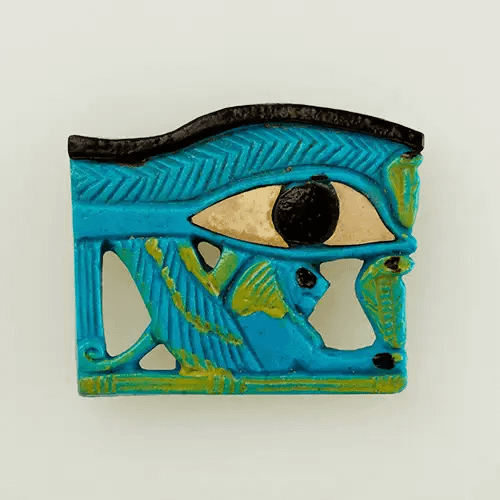

While making objects no longer required a final coating to turn blue like talc statues, skilled artisans had to managed multiple variations in raw materials. If the faience composite was too dry when shaped, it cracked; if shaped too damp, the thixotropic mixture slumped and could not hold a shape without a mold.
Before building the industry to manufacture faience scarabs, Egyptian engineers had to build an industry to make molds. Ancient clay molds were initially shaped by hand into a vessel about as shallow as a cupped palm. Often a design was engraved into the bottom of the mold to brand promotional products for festivals and celebrations. To meet the demand both in Egypt and through the Mediterranean, a mold making industry was set up to manufacture hundreds of thousands, maybe more, clay molds
Molds stabilized the gritty faience mixture but the drying time had to be managed carefully because objects had to come out of clay molds before completely dry. During the air drying process, carbonates and large particles of copper migrated from inside the objects up to the surface and formed an efflorescence, a salty, fine powdery layer. During the firing process about 1500 degrees F., the powdery surface fused into a glassy blue colored glaze. The laborious process of carving and glazing individual artifacts was replaced by mass produced brilliant blue talismans, scarabs, votive objects, figurines. Widely distributed at gatherings of all classes of Egyptians, the blue scarab may be among the first souvenirs.
Faience was also molded into ornamental tiles as wall art for royal tombs and probably homes of the elites. As many as 40,000 faience tiles in a range of blue colors were made for the tomb of III Dynasty King Djoser in the Saqqara complex near Cairo. The mosaic illustrated the “field of reeds” where pharaoh will find eternal rest. (The tiles can now be seen in the Metropolitan Museum in NYC.) The blue colors associated with Egyptian faience range from darker blue lapis to malachite tinged turquoise. The closer colors look to lapis blue, the more highly prized.
But even after Alexander the Great invaded Afghanistan about 2300 years ago and brought lapis lazuli pigment back to the delight of the artists and artisans, Egyptian blue pigment never left their palettes.

Wall tiles from the funerary apartments of King Djoser, Old Kingdom, ca. 2630–2611 B.C. © The Metropolitan Museum of Art
Header image: Winged Scarab amulet, Third Intermediate Period–Late Period, ca. 1070–525 B.C. © the Metropolitan Museum